
Most brands think they know how their customers shop online. They track sessions. They watch bounce rates. They run heatmaps on flat product pages and wonder why conversion stays stuck. What they are missing is the decision itself.
Buyer behavior analytics in visual commerce is a different category of data than what most ecommerce teams are working with. When a shopper interacts with a 3D product by rotating it, changing a finish, zooming into a detail, or spending 40 seconds on one configuration before switching to another, they are not just browsing. They are thinking out loud, each one of those micro-decisions is a signal.
This guide is for ecommerce managers and digital marketing leaders who want to understand what that data actually looks like, what it tells you, and how to build it into your product and conversion decisions. Dive in for a look at what behavior analytics looks like for your brand, whether you have a direct add-to-cart flow or use the digital product page to push confident leads to a dealer network.
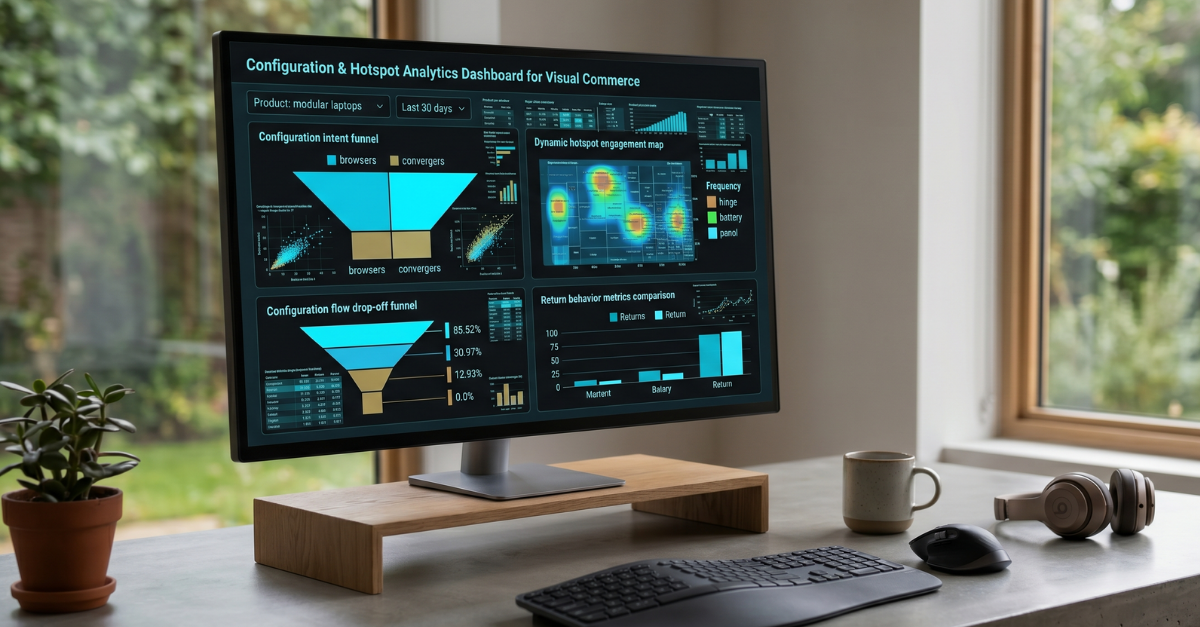
WHAT VISUAL COMMERCE DATA CAPTURES THAT TRADITIONAL ANALYTICS CAN'T
Standard ecommerce analytics tells you what pages people visited and where they dropped off. It tells you very little about what they were trying to figure out while they were there. Buyer behavior analytics in visual commerce captures interaction at the decision layer. When a shopper engages with a 3D product experience, you can see:
-
Which configuration options they opened first
-
Which angles they returned to most
-
Where they paused or slowed down in a product customization flow
-
Which finish, color, or option they hovered over without selecting
-
How long they spent before taking an action (add to cart, request a quote, find a dealer)
-
Which products they abandoned mid-configuration and what they had selected at the point of exit
This is not behavioral data as a proxy for intent, this is behavioral data as direct evidence of what a buyer needed and didn't find, what they considered and rejected, and what pushed them forward or stopped them cold.
For products where purchase decisions take weeks and where buyers are spending a significant amount of money this distinction matters enormously. The average flat product page tells a brand almost nothing about what a serious buyer needed to feel confident enough to act. A 3D interaction record tells you nearly everything. The signals that actually predict conversion Not all engagement is equal. Time on page is a weak signal. Interaction depth is a strong one.
In visual commerce, the interactions that correlate most closely with downstream conversion are those that reflect a buyer narrowing toward a decision:
Configuration specificity. A shopper who cycles through twelve finish options is browsing. A shopper who selects one, holds it, changes a secondary option, and returns to the original is converging. The second behavior is a purchase signal. Configuration data lets you identify these patterns at scale.
Hotspot engagement. When a buyer opens a guided selling hotspot or digs into a product detail panel, they are asking a question that wasn't answered by the product image. Which questions they ask, and which they don't ask because they couldn't find the answer, is product intelligence most brands have never had access to.
Return behavior. A shopper who leaves a configured product page and returns to the same configuration is significantly more likely to convert than one who browses broadly. Tracking saved or resumed configurations is one of the highest-signal data points in a visual commerce stack.
Drop-off within configuration flows. Where someone exits a multi-step customization flow is a direct indicator of friction. This is not the same as a general exit rate. It tells you which specific step created enough uncertainty to lose the sale.
Translating shopper interactions into product decisions
The operational value of this data is not just understanding what converted. It helps in understanding what to change.
Brands that use buyer behavior analytics well treat visual commerce interaction data the way a physical retailer treats floor observation. When a product sits in a store and customers consistently pick it up, examine one side, and put it back, a seller can watch that and respond. They can move the product, change the display, rewrite the signage, or reconsider the product itself.
Visual commerce gives you the same feedback loop for your digital product pages, but with more precision and at full scale.
Product configuration gaps. If a disproportionate number of shoppers are selecting a configuration option that drives low-margin outcomes, or if the data shows heavy interest in a variant you don't currently offer, that is a merchandising and product decision your analytics made visible. Multiple brands have used interaction data from their visual commerce implementations to identify configuration options that were underrepresented in their catalog. Options buyers clearly wanted but couldn't find.
Guided selling calibration. Hotspot and interactive element engagement data tells you whether your guided selling content is answering the right questions. If buyers are opening a hotspot on material composition but spending almost no time on the spec-level details you've prioritized, your content strategy and your buyers are not aligned. The data shows you the misalignment in real time.
Real-time engagement and personalization. Real-time engagement signals from visual commerce can feed into downstream experiences. A buyer who has spent time in a specific product category configuration can receive follow-up content, retargeting creative, or sales outreach that reflects exactly what they built instead of a generic "you viewed this product" prompt. The difference in conversion rates between those two approaches is not marginal.
What online buyer tracking looks like in a visual commerce context
Most ecommerce teams have experience with session tracking, UTM parameters, and conversion funnels. Visual commerce analytics operates on top of that infrastructure, but the events being tracked are different. Instead of page views and clicks, the events that matter in visual commerce are:
-
Model load and engagement start: did the shopper initiate the 3D experience or scroll past it?
-
First interaction type: did they rotate immediately, or start with configuration?
-
Configuration sequence: in what order did they make selections, and did they revise?
-
Time-to-decision events: how long elapsed between engaging with the product and taking a downstream action?
-
Feature engagement depth: which interactive elements were used, in what order, for how long?
-
Exit state: what was the buyer's last configured state when they left?
This event structure is what separates visual commerce tracking from standard online buyer tracking. You are not just observing traffic. You are observing thinking.
The brands that are building this into their analytics infrastructure have a durable advantage over those who do not. Not just in conversion optimization, but in product development, catalog management, and sales enablement. When your seller reaches out to a prospect who has spent 12 minutes building a specific product configuration, that conversation starts in a completely different place than a cold outbound call.
Building a measurement framework around visual commerce behavior
For ecommerce teams starting to think through how to capture and use this data, the practical framework comes down to three questions:
-
What are you measuring? Define the interaction events that matter for your specific product category. A hunting gear buyer and a luxury marine buyer have different decision patterns. The configuration events that predict conversion in one category may not be the same as another.
-
What does a high-intent interaction look like in your category? Establish a baseline for what engaged vs. casual looks like in your data. Not every configuration interaction is a purchase signal. A buyer who clicks through options in under three seconds is exploring. A buyer who pauses, revises, and spends time with a specific selection is converging. The difference is measurable.
-
How does this feed back into the business? Buyer behavior analytics from visual commerce is most valuable when it connects to three downstream functions: product team (what to build, prioritize, or retire), marketing team (what to amplify, what gaps to address in content), and sales team (which accounts are showing intent, and what they need to close). If the data lives only in a reporting dashboard, it is not working hard enough.
THE GOLD MOST BRANDS STILL HAVEN'T mined
Most ecommerce teams with 3D on their product pages are not capturing this data in any structured way. They implemented visual commerce for the shopper experience, which was the right move. But they left significant analytical value on the table by treating it as a front-end feature rather than a data infrastructure investment.
The advantage doesn't come from throwing 3D onto your PDP, brands only see true ROI when they have built a system to learn from every interaction inside those experiences and fed that learning back into every function that touches the buyer.
That is the difference between visual commerce as a conversion tactic and visual commerce as a buying intelligence platform.
Dopple builds 3D product experiences for brands in enthusiast industries and provides the behavioral intelligence layer that makes those experiences operationally valuable. If you want to see what your buyers are actually doing inside your product experience book a demo.