
A marine buyer has been thinking about this purchase for six months. They know the hull length, the engine configuration, they have a slip in mind. They've watched hours of review content, talked to two dealers, and they are ready to get serious. They land on a brand's product page.
They get a photo gallery that is simultaneously beautiful and underwhelming, and scroll for a PDF spec sheet.
That moment between what the buyer arrived with and what the brand built is where most high-consideration deals stop. The buyer was already mid-decision, and arrived at a digital experience built for someone who was still browsing. This is the problem Situational Commerce was designed to solve.
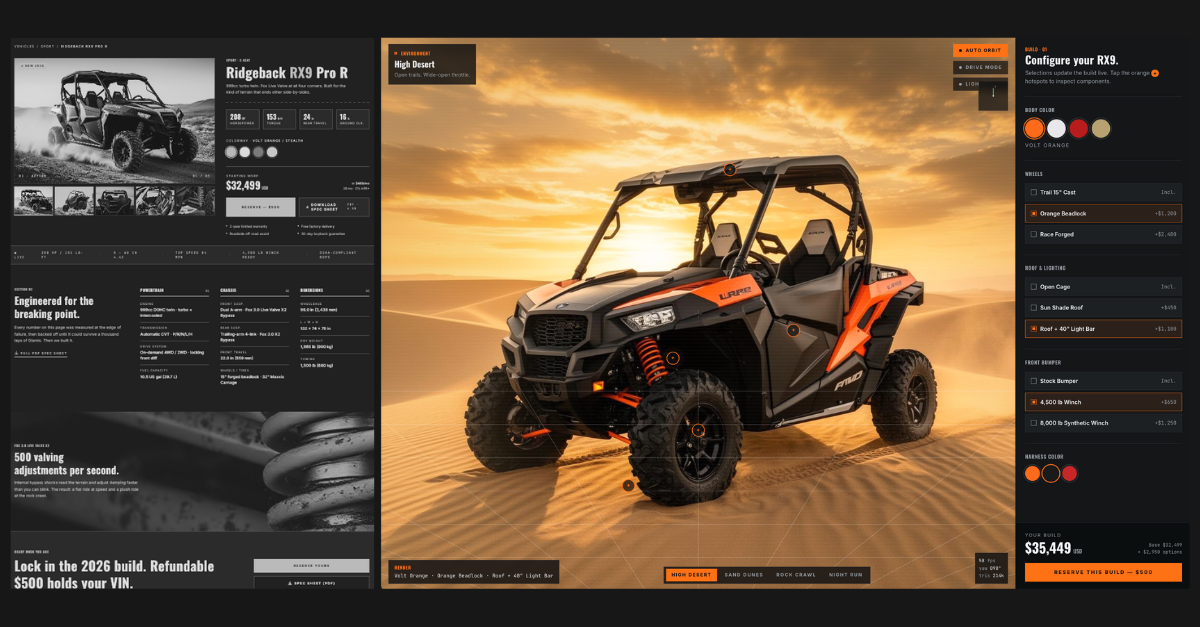
What Situational Commerce actually means
Situational Commerce describes what buyers in high-consideration categories actually need from a digital product experience: an experience that responds to their specific context. Their intended configuration. Their environment. Their use case. Not a generic product page that talks to no one in particular. An experience that understands the buyer arrived with something specific in mind and meets them there.
It is not personalization in the marketing sense. It is not AI-generated copy or a recommended products widget. It is the ability for a buyer to interact with a product in the context of their actual intended purchase, and for that interaction to tell both the buyer and the brand something real about what they are trying to decide.
The distinction matters because most teams conflate "digital experience" with "better content." More photos. A 360-degree spin. A video. These are improvements to a discovery page. Situational Commerce starts from a different premise: by the time a serious buyer lands on your product page, they are not there to discover. They are there to decide.
The wrong buyer problem
Most product pages were designed for a buyer who needs to be introduced to the product. Someone earlier in the funnel, still learning what exists, still forming a preference. This design logic is appropriate for low barrier impulse categories. It is wrong for products that cost $20,000, $80,000, or $500,000.
A firearms buyer who has spent two months spec'ing a build is not looking for an overview of the caliber options. They want to configure their exact finish, their preferred optic setup, and confirm the combination looks the way they've been picturing it. A machinery buyer evaluating attachment compatibility is not there to watch a brand video. They want to understand whether the attachment works for their specific machine and operating conditions without having to source the information from scrappy Youtube videos or online forums.
The buyer who is closest to purchasing is the one most underserved by a page built for discovery. That is where the revenue loss happens. Not at the top of the funnel, but in the window when the decision is forming and the brand has nothing to offer except information the buyer already has.
The competitor-gap
There are brands who are ahead of the curve and have already built for Situational Commerce, and they know something the others are about to find out.
When a buyer encounters an experience that actually responds to their context. A fluid experience that lets them configure their product in their intended setup, interact with it the way they would in a showroom, and see the specific version they are considering. That buyer does not go back to a static product page. The gap is not subtle. It reads, at a visceral level, as: one brand understands me as a buyer. The other one is talking to someone else.
That perception transfers to everything. The buyer's confidence in the product, their trust in the brand, their estimate of the company's sophistication. All of it is shaped by whether the digital experience was built for their situation or for an abstracted average customer who doesn't actually exist.
This is why competitive gap is one of the three consistent triggers that move buyers toward a conversation. When someone sees a competitor's experience and then returns to their own brand's product page, the comparison is not academic. It changes what they think is possible. It changes what they expect from a brand that wants their business.
What it looks like when the experience is built right
A gear buyer configuring their exact finish and optic combination, generating a shareable build that reflects their specific setup. A marine buyer placing their chosen boat model in a coastal environment and viewing it the way they actually intend to use it. A heavy equipment buyer walking through attachment compatibility before they have called a dealer.
This is not technology for technology's sake. It is the commercial logic of selling products that require real consideration: you have to give the buyer something to consider. And consideration requires context. The buyer who can configure their intended purchase in a digital environment leaves that interaction with more conviction, more specific questions, and more commitment to a decision than the buyer who looked at a photo and filled out a contact form.
Buyer behavior data from Dopple-powered experiences across many different industries have consistently shown that engagement with a configurator or interactive environment corresponds with a measurable shift in purchase intent signals. The buyer who spends time with the experience is not the same buyer who bounced from the spec sheet. They are further along, they know more specifically what they want, and they are ready for a different kind of conversation.
What this means for the second half of 2026
To be clear, Situational Commerce is not a product feature. It is a strategic decision about who you are building for and how they will experience the product story you are telling. It is building a digital experience for the deciding buyer, not the browsing buyer.
Dopple first outlined the business case for Situational Commerce in our 2024 white paper, before the competitive environment made the argument for us. The data on buyer behavior, configuration engagement, and purchase confidence is in that report. So is the framework for how brands in complex product categories can close the gap between what serious buyers need and what most brands are currently offering.
If the second half of 2026 is when your buyers start comparing experiences, you want to know what the comparison looks like before they make it.
The business case for Situational Commerce is already documented.
In 2024, Dopple published a detailed look at how buyer behavior in high-consideration categories differs from standard e-commerce, and what the commercial consequences are for brands that build digital experiences without accounting for it. The data, the framework, and the vertical-specific findings are in that report. Download the Unseen Influence of 3D in the Age of AI