
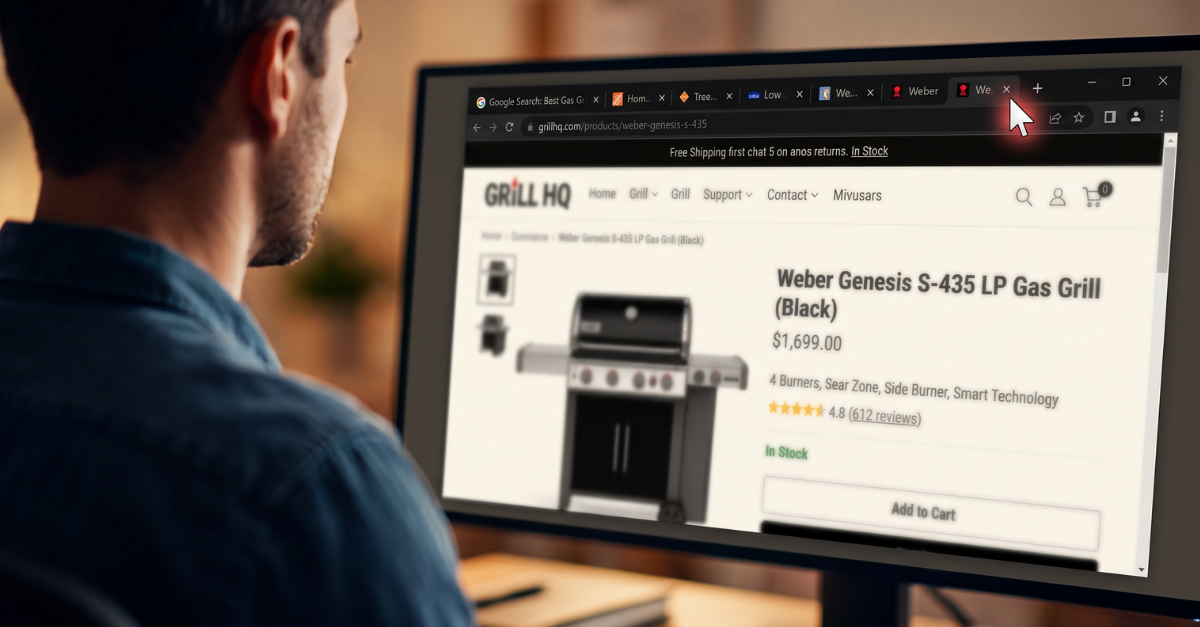
Somewhere in your analytics right now is a buyer who rotated your product forty-one times, opened three configurations, sat on the finish options for two full minutes, and left. Marketing calls that a bounce. That buyer told you more about what it would take to close them than your last ten sales calls combined, and the business has no idea, because nobody was built to hear it.
We spend our days sitting inside that exact moment, watching buyers move around a product on a screen the way they'd move around it on a showroom floor. Not scrolling. Circling. Checking the seam where two parts meet. Coming back to the same angle three times. It's a physical instinct applied to a digital object, and it produces something most companies have never had access to before: a record of exactly what a buyer needed to trust the purchase, down to the angle and the second.
The page tells you someone visited. It doesn't tell you what they needed.
Time on page, bounce rate, session count. These describe traffic. They were built for a world where the product itself couldn't tell you anything, so the best you could do was measure the room around it.
That's no longer the ceiling. When the product is a real digital twin, the model itself becomes the instrument. It knows which face got studied and which got ignored. It knows the configuration a buyer built and then walked away from without saving. It knows the exact hotspot they opened right before they closed the tab. None of that is traffic. That's the buyer's actual reasoning, captured at the source instead of guessed at downstream.
That reasoning has a name. Visual intelligence is the ability to reason about how a product looks, fits, and configures in context, rather than as a fixed image on a page. Right now, the buyer sitting on your finish options is doing that reasoning manually, alone, with no one to hand the answer to. Soon, an AI agent shopping on their behalf will need to do the exact same reasoning and will need your product data built to supply it. It's the same missing layer showing up twice: once as a human stalling on your page today, once as an agent that won't be able to act on your product tomorrow if the context isn't there to reason over.
Do that reasoning across every buyer who's touched a model and you get something bigger than a heatmap. You get product intelligence: an accumulating record of what your own product needs to say that it currently isn't saying.
A buyer who stalls isn't gone. They're mid-question.
Every industry we work in has a version of the same person: someone standing in front of a purchase they've wanted for years, spending real money, unwilling to be wrong about it. That person doesn't abandon a product page out of boredom. They abandon it because the page ran out of answers before they ran out of questions.
In person, that gap used to close itself. Someone on the floor caught the hesitation and answered it before the buyer even had to ask out loud. Online, the hesitation just ends the session. Nobody upstream ever learns that a specific, answerable question was the actual reason the deal stalled.
There's a name for building toward that instead of away from it: situational commerce, the practice of adapting the product experience to a buyer's specific context, their use case, environment, and intent, instead of showing every buyer the same static catalog page. A stalled buyer isn't evidence that situational commerce doesn't matter. It's the clearest evidence that it does.
Every stalled buyer becomes someone else's cost.
That unresolved buyer doesn't disappear. They go quiet for a few weeks and half of them never come back. They call a dealer and make someone answer, on the phone, a question the product already knew. Or they open a second tab, find a competitor whose experience happened to show the one detail yours didn't, and hand that competitor the sale on information you had first.
None of those are traffic problems. They're all the same problem: an answer that existed and a buyer who never saw it in time.
The data was always going to say this. The question was whether anyone built something that could listen.
This is what we mean when we say we get to know a brand's product and its buyers more intimately than the brand itself does. Not because we watch more people. Because we're built to read the part of the interaction everyone else has been throwing away: the forty-one rotations, the abandoned configuration, the finish nobody could decide on.
The digital showroom isn't a nicer photo of the product. It's the first version of the sales floor that remembers every conversation it ever had, including the ones that didn't end in a sale.